North Jersey Flagpole Crew handles flagpole installation and repair across North Jersey for homeowners, businesses and public buildings. We install commercial poles with internal halyards, wall-mounted models for storefronts and homes, and rooftop poles on taller buildings. Our repair work ranges from a re-rope to a full pole replacement and covers frayed halyards, broken snap hooks, faded finishes and missing finials. Contact us for a free quote today.
-
What Are the Signs a Flagpole Actually Needs Repair or Reinstallation?
The most telling sign is movement at the base. If the pole rocks when you push on it at shoulder height, it has lost its grip in the foundation, even if it still looks dead straight from the street. Most other problems show up either in the hardware at the very top or in the metal right at ground level. Each one points to a different repair, so walk around the pole and look up before you call anyone.
- Pole leans or wobbles when pushed at the base
- Halyard rope is fuzzy, flattened, or fraying along its length
- Truck pulley at the top squeals or won't turn
- Rust, pitting, or cracks right at the ground sleeve line
- Flag keeps snagging or wrapping around the shaft
-
Does a Leaning or Wobbling Pole Mean the Whole Flagpole Has to Be Replaced?
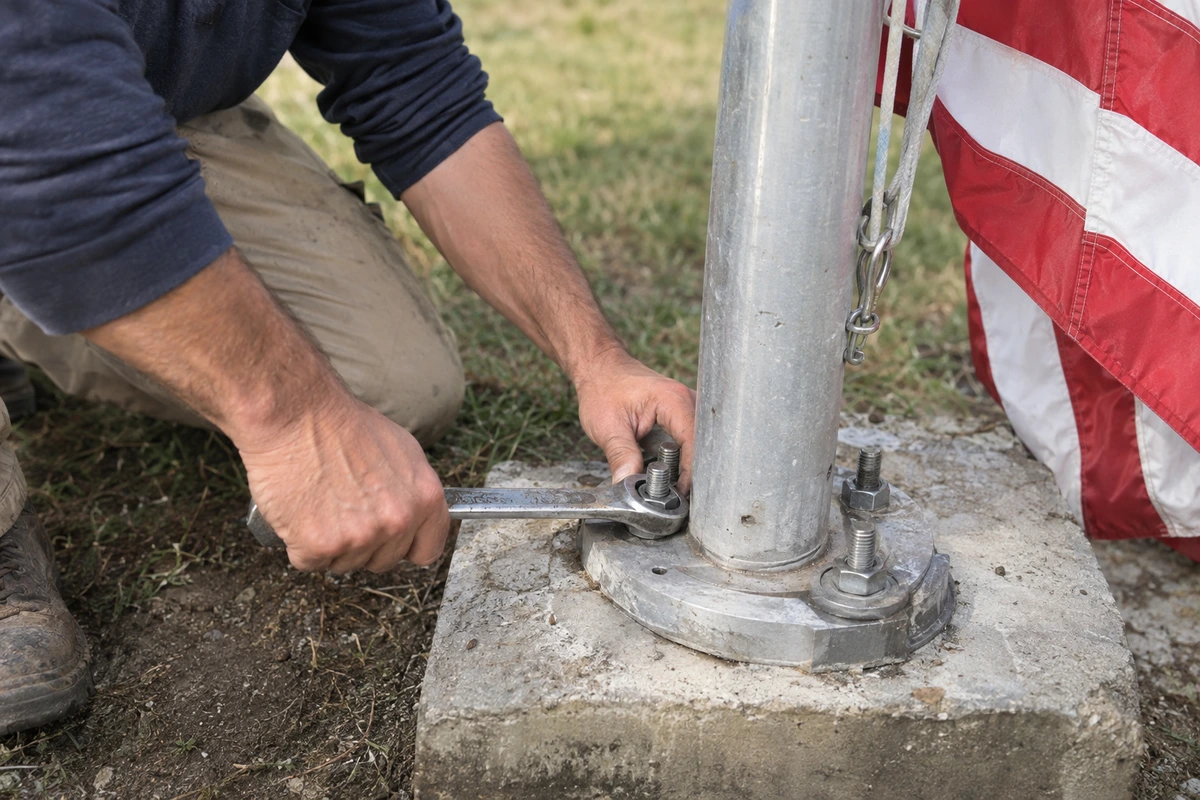
Usually not. On a ground-set pole, the wobble almost always comes from the foundation sleeve, the steel or PVC tube set in concrete. Over time the sand fill or wedges between the pole and sleeve wash out or compress, and the shaft starts to rock. Resetting it means pulling the pole, re-plumbing it with a level on two faces, repacking it with dry sand, and sealing the top with a flash collar and caulk so rainwater stops draining into the sleeve. If the concrete itself has cracked or heaved from frost, we break out the foundation and repour it, and the new concrete needs several days to cure before the pole goes back under wind load.
-
How Often Does a Frayed Halyard Rope Need Replacing, and What Wears It Out?
Once a halyard shows fuzzy or flattened sections, replace it before it parts. A snapped rope leaves the flag stuck at the top, and the only way to get it down is a lift or bucket truck. The wear comes from UV breaking down the braided polyester or nylon, plus constant flexing where the rope rides over the pulley and slaps the shaft in the wind. Most residential halyards last a few years in full sun, and less on exposed, windy sites. To swap one, tie the new line to the old one and pull it through the pulley before cutting the worn rope free. Then check that the cleat is bolted tight, because a loose line only adds to the rubbing.
-
Will Oiling a Squealing or Stuck Truck Pulley Fix It for Good?
At best, it buys you a few quiet weeks. The truck is the cap assembly at the top that holds the pulley sheave, and once it squeals or binds, the axle or bushing has usually corroded or worn oval. No lubricant reverses that. Grease also traps airborne grit and grinds the bushing down faster than leaving it dry would. The lasting fix is replacing the truck or the sheave, which on most poles means lowering the pole or bringing in a lift, so I'd replace the halyard on the same visit. A seized pulley will chew through even a brand-new rope in a single season, which is why these two problems so often show up together.
-
Is Rust or Cracking at the Ground Sleeve Line Just Surface Damage?
Rarely, and it's the sign that worries me most. The groundline is where moisture, lawn fertilizer, and mower or trimmer nicks all concentrate. On steel poles, water trapped in the sleeve thins the wall from the inside, so the outside may show only light rust while the metal underneath is badly eaten away. Aluminum doesn't rust, but it pits and can develop fatigue cracks at that same spot after years of wind flexing the pole back and forth. Tap around the base with a screwdriver handle. Any soft, flaking, or hollow-sounding spot calls for replacement, not paint, because that's exactly where poles snap in a storm.
-
Why Does the Flag Keep Snagging or Wrapping Around the Pole?
Wrapping happens when the flag can't swing freely as the wind shifts, so it winds around the shaft instead of turning with it. A fixed truck holds the halyard and flag on one side of the pole, and the swirling, gusty wind you get near houses and trees makes it much worse. A revolving truck spins on a bearing so the whole assembly follows the wind, while rotating snap hooks and a weighted counterpoise on the lower halyard keep the bottom of the flag from flipping over the top. Keep the halyard snug at the cleat, too, since slack lets the line bow out and catch the flag on the far side of the pole.